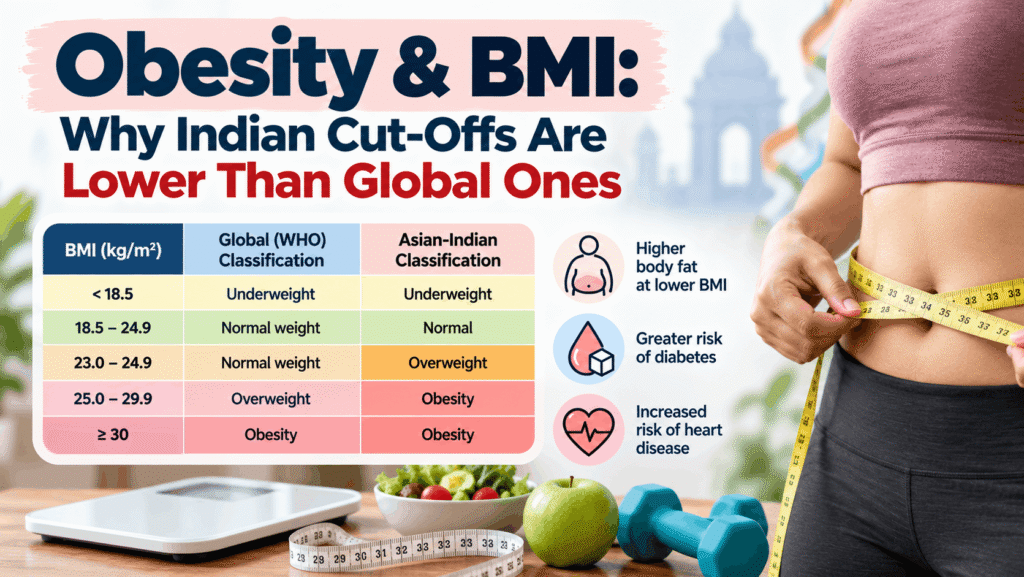
Quick Answer: The BMI thresholds for Indians are lower since metabolic risks can appear at lower BMI levels; under the usual Asian-Indian standards, a BMI of 23 may already be considered to indicate overweight. Waist circumference also matters because abdominal fat can increase the risk of both diabetes and heart disease. Considering both BMI and waist size can give you a better sense of your overall health.
Introduction
If you’ve ever checked your BMI online, you may have noticed something confusing: the same BMI number can mean different things depending on the guideline being used. For example, a BMI of 24 may be considered normal under the standard international classification. But under commonly used Asian-Indian criteria, the same BMI falls into the overweight category called as obesity.
Then here’s the situation: the BMI formula remains the same. As before, your weight is divided by your height squared. What has changed, though, is where health professionals set the cutoff points for evaluating health risks.
Research has shown that Asian populations, including Asian Indians, can develop metabolic problems such as type 2 diabetes and cardiovascular disease at lower BMI levels than some other populations. This is one reason lower BMI thresholds are used when assessing Asian Indians.
But there’s an important catch: BMI is only one part of the picture. Your waist size, blood pressure, blood sugar, cholesterol, physical activity and family history can all tell us more about your health than BMI alone. Let’s look at what the numbers really mean.
What Is BMI?
BMI, or body mass index, is a simple calculation that compares your weight with your height.
The formula is:
BMI = Weight (kg) ÷ Height (m)²
For example, if you weigh 70 kg and are 1.70 metres tall:
70 ÷ (1.70 × 1.70) = 24.2 kg/m²
BMI is popular because it’s quick, inexpensive and easy to calculate. It can help identify people who may be heavier or lighter relative to their height. However, BMI doesn’t actually measure body fat.
It also can’t tell whether your weight comes from muscle, fat, bone, or other tissues. That’s why BMI should be treated as a screening tool, not a complete picture of someone’s health.
What Are the Standard Global BMI Cut-Offs?
The conventional WHO classification for adults is:
| BMI (kg/m²) | Standard classification |
| Below 18.5 | Underweight |
| 18.5–24.9 | Normal weight |
| 25.0–29.9 | Overweight |
| 30.0 or above | Obesity |
These categories are widely used worldwide. The WHO defines overweight in adults as a BMI of 25 or higher and obesity as a BMI of 30 or higher. But these aren’t the only thresholds used in clinical practice.
For Asian populations, researchers have found that certain health risks may become more noticeable at lower BMI values. That’s where the Asian-Indian cut-offs come in.
What Are the BMI Cut-Offs for Indians?
For Asian Indians, commonly used clinical criteria classify BMI as follows:
| BMI (kg/m²) | Asian-Indian classification |
| Below 18.5 | Underweight |
| 18.5–22.9 | Normal |
| 23.0–24.9 | Overweight |
| 25.0 or above | Obesity |
So, BMI 23 is an important threshold.
A person with a BMI of 23 doesn’t automatically have a health problem. Instead, the number suggests metabolic risk may warrant closer attention. Similarly, a BMI of 26 is classified as obesity under the commonly used Asian-Indian criteria, even though it would fall into the overweight category under the standard WHO classification.
BMI Chart India: Global vs Asian-Indian Cut-Offs
Seeing the two systems side by side makes the difference much easier to understand.
| BMI | Standard global classification | Common Asian-Indian classification |
| <18.5 | Underweight | Underweight |
| 18.5–22.9 | Normal | Normal |
| 23.0–24.9 | Normal | Overweight |
| 25.0–29.9 | Overweight | Obesity |
| ≥30 | Obesity | Obesity |
The key point is that the BMI calculation itself is the same.
Why Are Indian BMI Cut-Offs Lower?
The main reason is that body composition and fat distribution can differ between populations. Studies have found that South Asian populations may carry more body fat, particularly around the abdomen, at the same BMI compared with some other populations. That matters because abdominal and visceral fat are closely linked with metabolic problems such as insulin resistance and type 2 diabetes.
In simple terms, two people can have the same BMI but not necessarily have the same amount or distribution of body fat. Research involving South Asian populations has described greater central fat accumulation at lower BMI levels and its association with metabolic risk. This doesn’t mean that every Indian person with a BMI above 23 is unhealthy.
It simply means that the BMI number may need to be interpreted more carefully.
Is BMI 23 Overweight for Indians?
Under commonly used Asian-Indian criteria, yes.
- A BMI between 23 and 24.9 kg/m² is classified as overweight.
- A BMI of 25 kg/m² or above is classified as obesity.
But don’t look at these numbers as a sudden switch between “healthy” and “unhealthy.” For example, someone with a BMI of 22.9 isn’t automatically healthier than someone with a BMI of 23.1. These cut-offs help identify population-level risk, not judge an individual based on a 0.2 BMI difference.
Your overall health still matters more.
Why Your Waist Size Matters Too
Here’s something BMI can’t tell you: where your body stores fat. Two people can have the same BMI but very different waist measurements. One might have relatively little abdominal fat, while the other may carry considerably more around the waist.
This is important because abdominal fat is associated with metabolic health problems.
For Asian Indians, commonly used waist circumference thresholds are:
| Sex | Waist circumference |
| Men | ≥90 cm |
| Women | ≥80 cm |
These thresholds are used in Asian-Indian clinical guidance to identify increased risk of abdominal obesity. So if you’re checking your BMI, it’s also useful to pay attention to your waist circumference.
BMI vs Waist Circumference: What’s the Difference?
Think of BMI as giving you a broad overview, while waist circumference adds another layer of information.
| Measurement | What it tells you | Limitation |
| BMI | Weight relative to height | Doesn’t show where fat is stored |
| Indicates | Measurement technique can affect results | |
| Waist-to-height ratio | Relates waist size to height | Less routinely used |
| Body-fat percentage | Estimates how much of your body weight is fat | Accuracy depends on the method |
None of these measurements is perfect on its own. Using them alongside blood pressure, glucose, cholesterol and medical history gives a much more useful picture.
Why Is Abdominal Fat Important?
Not all body fat behaves in the same way. Fat around the abdomen, particularly visceral fat, is associated with metabolic changes that can contribute to:
- Insulin resistance
- Type 2 diabetes
- High blood pressure
- Abnormal cholesterol
- Cardiovascular disease
This is one reason South Asian populations may benefit from paying attention to waist circumference in addition to BMI. For example, imagine two people with a BMI of 23.5. One has a relatively small waist, while the other has significant abdominal fat.
Their metabolic risk may differ. That doesn’t mean waist circumference can diagnose a health condition on its own. It simply gives healthcare professionals another useful piece of information.
How Do You Measure Your Waist?
Measuring your waist at home is fairly simple, but try to do it consistently.
Follow these steps
- Stand upright and relax your stomach.
- Keep your feet together.
- Place a flexible measuring tape around your abdomen.
- Keep the tape level so it doesn’t slope.
- Make sure it is snug, but not so tight that it presses into your body or pulls your stomach in.
If you’re monitoring your waist over time, try to use the same measurement method each time. For a clinical assessment, healthcare professionals may use a standardised measurement technique.
Can You Have a Normal BMI and Still Have Health Risks?
Yes. This is one of BMI’s most important limitations.
Someone can have a BMI in the normal range and still have:
- High blood pressure
- High blood glucose
- High cholesterol
- Excess abdominal fat
- Insulin resistance
- A sedentary lifestyle
- A strong family history of diabetes
This is particularly relevant when discussing Asian Indian populations because metabolic problems can occur at lower BMI levels. So, normal BMI doesn’t automatically mean zero health risk.
Can You Have a High BMI Without Having Excess Body Fat?
You can. BMI doesn’t distinguish between muscle and fat.
For example, someone who does regular strength training may have a relatively high BMI because of their muscle mass without having excessive body fat. This is another reason why BMI shouldn’t be used on its own to label someone as unhealthy.
If BMI doesn’t seem to match your body composition, a healthcare professional can consider other measurements.
What Does a BMI of 24 Mean for an Indian Adult?
This is a good example of why the different cut-offs can be confusing.
| Classification | BMI 24 |
| Standard WHO classification | Normal |
| Common Asian-Indian classification | Overweight |
Does that mean someone with a BMI of 24 is unhealthy? Not necessarily.
It means that, under the Asian-Indian classification, the person may have a higher metabolic risk than someone with a lower BMI. Other factors should then be considered, such as waist circumference, blood pressure, blood glucose, cholesterol, lifestyle, and family history.
What Does a BMI of 26 Mean?
A BMI of 26 is:
- Overweight under the standard WHO classification
- Obesity under commonly used Asian-Indian criteria
Again, this doesn’t mean the person suddenly became unhealthy because their BMI crossed from 24.9 to 25. The cut-off is a practical clinical tool for identifying increased risk.
A healthcare professional should look at the whole picture, rather than focusing on the BMI number alone.
Why Is This Important for Diabetes?
Type 2 diabetes is one of the major concerns when discussing obesity and BMI in South Asian populations. Research has found that Asian Indians can develop diabetes and other metabolic abnormalities at lower BMI and waist measurements than some other populations. That’s one reason lower thresholds can be useful.
The idea isn’t to label more people as obese. It’s about spotting potential risk earlier. For example, if someone has a BMI of 23, a large waist circumference, high blood pressure and elevated blood glucose, waiting until their BMI reaches 30 before paying attention doesn’t make sense.
Early awareness gives people an opportunity to discuss lifestyle changes and appropriate screening with their healthcare professional.
What Should You Do If Your BMI Is 23 or Higher?
First, don’t panic. A BMI of 23 isn’t a diagnosis. Instead, use it as a reason to take a closer look at your overall health.
1. Check your waist circumference
If your BMI is elevated, then measuring your waist will give extra information regarding abdominal fat, with the thresholds usually applied to Asian Indians being 90 centimetres for men and 80 centimetres for women.
- Check your blood pressure
High blood pressure usually has no noticeable symptoms and can be detected early with regular monitoring.
3. Pay attention to blood glucose
If you have risk factors for diabetes, your healthcare professional may recommend tests such as fasting blood glucose or HbA1c.
4. Know your cholesterol levels
A lipid profile can help identify cholesterol or triglyceride abnormalities that may increase cardiovascular risk.
5. Look at your daily habits
Ask yourself:
- Am I physically active?
- Do I regularly eat vegetables and fruits?
- How often do I have sugary drinks?
- How much processed food do I eat?
- Am I sleeping well?
- Do I smoke?
- Do I drink alcohol regularly?
You don’t need to change everything at once. Even small changes can be more useful if they’re realistic enough to stick with.
Lifestyle Changes That Can Support Healthy Weight
If you’re worried about your BMI or waist circumference, you don’t need to start a very strict diet right away. Instead, consider habits you can actually keep up.
Build balanced meals
- Try to include vegetables, pulses, whole grains, protein sources, fruits, and healthy fats in your meals.
- You don’t necessarily have to eliminate foods such as rice or roti.
- Instead, consider portion size, variety and the overall balance of your meal.
Move regularly
- Exercise doesn’t have to mean spending an hour at the gym.
- Walking, cycling, swimming, dancing, playing a sport or doing strength exercises can all help you stay active.
- WHO recommends that adults generally aim for at least 150 minutes of moderate-intensity physical activity each week, although individual recommendations can vary.
Get enough sleep
- Sleep often gets overlooked when people talk about weight.
- A regular sleep schedule and adequate sleep can support overall health and make it easier to maintain healthy routines.
Avoid extreme diets
- Be careful if a diet claims significant weight loss in a very short time.
- Instead of asking:
How fast can I lose weight?
- Try asking:
What realistic changes can I still keep six months from now?
- It will be much more useful in the long term.
BMI and Waist Circumference: A Simple Guide
| Your situation | What it may mean |
| Normal BMI + normal waist | Lower risk based on these measures, although risk isn’t zero |
| Normal BMI + high waist | Abdominal fat may need further assessment |
| Higher BMI + normal waist | BMI may not fully reflect body composition |
| Higher BMI + high waist | Greater metabolic risk may be present |
| Higher BMI + high blood glucose | Further assessment for diabetes or prediabetes may be appropriate |
These are general examples, not diagnostic categories. Your age, sex, medical history, medications, family history and laboratory results can all change how these measurements should be interpreted.
Should You Focus Only on Your Weight?
Probably not. It’s easy to become obsessed with whether your BMI is 22.8, 23.2 or 24.1. But your health doesn’t suddenly change because a calculator moves across a particular cut-off. These thresholds help identify people who may have increased risk.
They’re not magical lines separating “healthy” from “unhealthy.” For example, a person with a BMI of 22.8 could still have high blood pressure or diabetes, while someone with a BMI of 23.2 may have otherwise healthy metabolic measurements. The number is useful.
But the bigger picture matters more.
Frequently Asked Questions
1. What is the normal BMI for Indians?
A commonly used Asian-Indian classification considers 18.5–22.9 kg/m² to be the normal range. BMI 23.0–24.9 is classified as overweight, while BMI 25 or above is classified as obesity.
- Is BMI 23 considered overweight for Indians?
Research suggests that Asian populations may face metabolic risks at lower BMI levels than conventional global thresholds. Therefore, BMI 23 is used as an important risk threshold in Asian-Indian clinical guidance.
3. Is BMI enough to determine obesity?
No. BMI is a screening measure and doesn’t directly measure body fat or show where fat is stored. Waist circumference and other health measurements can provide additional information.
4. Can someone have diabetes with a normal BMI?
Yes. BMI doesn’t capture every aspect of metabolic health. Asian Indians may develop metabolic problems at lower BMI levels, and factors such as abdominal fat, family history, diet, and physical activity also matter.
5. Should I lose weight if my BMI is 23?
Not based on BMI alone. A BMI of 23 is classified as overweight under commonly used Asian-Indian criteria, but your waist circumference, metabolic health, medical history and lifestyle should also be considered.
Conclusion
If you’ve ever wondered why an Indian BMI chart gives you a different result from an international BMI calculator, the explanation is fairly simple.
The formula doesn’t change. The risk thresholds do.
For Asian Indians, commonly used criteria classify:
- 18.5 – 22.9: Normal
- 23 – 24.9: Overweight
- 25 or above: Obesity
Think of BMI as a starting point for understanding your health, not the final answer.
Medical disclaimer: This article is intended for general educational purposes and does not replace personalised medical advice. BMI and waist circumference are screening measures and should be interpreted alongside an individual’s overall health and medical history.
References
- https://www.who.int/news-room/fact-sheets/detail/obesity-and-overweight
- https://www.who.int/europe/news-room/fact-sheets/item/nutrition—maintaining-a-healthy-lifestyle
- https://pmc.ncbi.nlm.nih.gov/articles/PMC10078503/
- https://pmc.ncbi.nlm.nih.gov/articles/PMC7328526/
- https://pmc.ncbi.nlm.nih.gov/articles/PMC3738996/