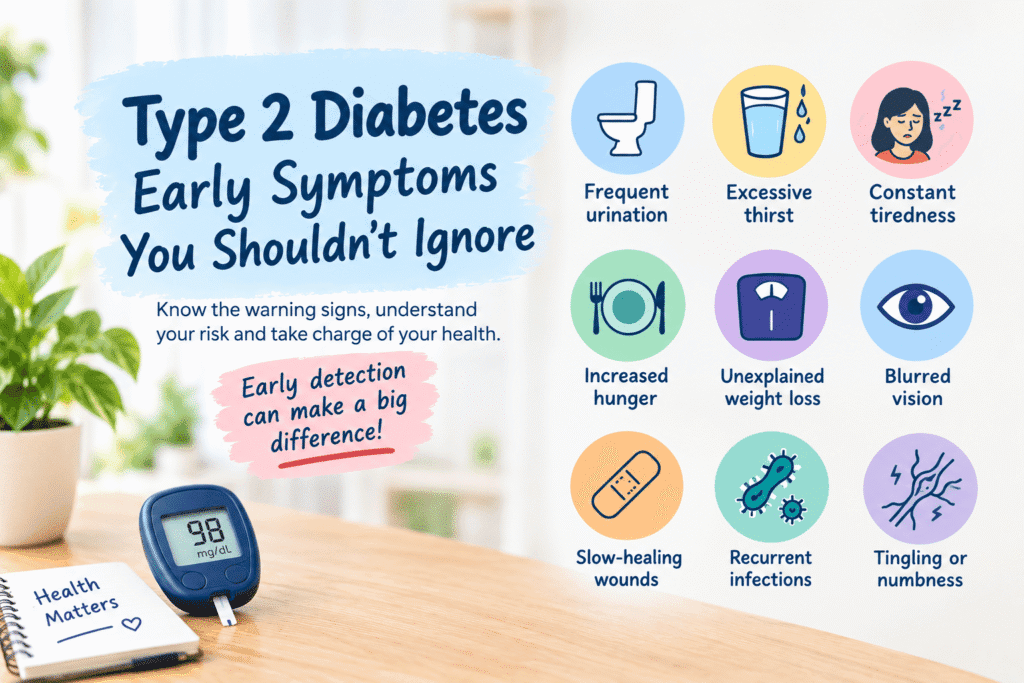
Quick Answer: Type 2 diabetes can progress without being noticed. Symptoms such as tiredness, a greater thirst, needing to go to the bathroom more often, or unexpected weight changes are generally taken for granted as part of aging, stress, or ordinary fatigue. If these symptoms are identified early, it may lead to timely testing and treatment.
Introduction
Most of us don’t think much about diabetes until someone in the family is diagnosed with it. A little extra thirst? Probably the heat. Feeling tired all day? Maybe it’s work stress. Going to the bathroom more often? Perhaps you’ve just been drinking more water. These changes can seem harmless, but sometimes they are early warning signs of type 2 diabetes.
The difficult thing is that diabetes doesn’t always cause you to feel unwell at first; some people can have high blood sugar for a long time without noticing any strange symptoms. This is particularly important in India, since diabetes has become more common there. The ICMR-INDIAB study states that in 2021, about 101 million people in India were living with diabetes, and an additional 136 million had prediabetes.
There’s also a common misconception that diabetes mainly affects people who are overweight. For Indians and other South Asians, that’s not always the case. You can look slim on the outside and still carry excess fat around your abdomen and internal organs; a pattern often described as the “thin outside, fat inside” or thin-fat phenotype.
So, what are the type 2 diabetes early symptoms that you shouldn’t brush aside? Let’s break them down.
What Is Type 2 Diabetes Mellitus?
Type 2 diabetes mellitus develops when your body stops responding properly to insulin, the hormone that helps move glucose from your blood into your cells for energy. At first, your pancreas may compensate by producing more insulin. Over time, however, it may not be able to keep up. Blood glucose levels then begin to rise.
The problem is that this process can happen quietly. You may continue going to work, eating normally, and carrying on with your daily routine without realizing that your blood sugar is gradually increasing. That’s why knowing the early warning signs of diabetes and understanding your personal risk factors can be useful.
Type 2 Diabetes Early Symptoms to Watch For
Not everyone experiences the same symptoms. Some people may notice several changes, while others may have almost none. Here are some common signs that are worth paying attention to:
| Possible warning sign | Easy to mistake it for |
| Frequent urination | Drinking too much water or tea |
| Excessive thirst | Hot weather |
| Constant tiredness | Stress or lack of sleep |
| Increased hunger | Having a naturally large appetite |
| Unexplained weight loss | Eating less or being more active |
| Blurred vision | Eye strain or needing new glasses |
| Slow-healing wounds | It’s only a small cut |
| Recurrent infections | Being prone to infections |
| Tingling or numbness | Sitting or sleeping awkwardly |
Having one of these symptoms doesn’t necessarily mean you have diabetes. There can be many other explanations. But if several symptoms continue or appear together, it’s worth talking to a healthcare professional.
Warning signs
1. You’re Suddenly Going to the Bathroom More Often
Have you noticed that you’re urinating more often than usual? Maybe you’re waking up at night to use the bathroom, or perhaps you seem to need the toilet much more frequently during the day. It’s easy to dismiss this, especially if you drink several cups of tea or coffee or make an effort to drink plenty of water.
But frequent urination can happen when blood glucose becomes too high. The kidneys try to remove the excess glucose through urine, and this can result in increased urine production. If this is a persistent change for you, don’t simply assume it’s part of your routine.
2. You’re Thirsty All the Time
Frequent urination can also leave you feeling unusually thirsty. You may drink a glass of water and find yourself reaching for another one soon afterwards. In India’s hot climate, it’s particularly easy to blame thirst on the weather.
Occasional thirst is completely normal. Constant or unusually strong thirst, especially when it comes with frequent urination, deserves more attention.
3. You’re Tired Even After Sleeping
Everyone has days when they feel exhausted. The thing to notice is when tiredness becomes your new normal. You may sleep reasonably well but still wake up feeling drained. Simple tasks might take more effort than they used to, or you may feel like your energy disappears halfway through the day.
High blood sugar can contribute to fatigue, although tiredness has many possible causes, including poor sleep, stress, anaemia and thyroid problems. If your fatigue persists, it’s better to find out what’s causing it rather than simply pushing through it.
4. You’re Hungry Again Soon After Eating
Feeling hungry before your next meal is normal. But if you’re eating properly and still feel unusually hungry all the time, it may be worth paying attention to, particularly if you’re also experiencing thirst, tiredness, or changes in weight.
If the body is unable to use glucose effectively as a source of energy, this can have an effect on hunger and on energy levels. However, an increased appetite by itself is not sufficient for diagnosing diabetes; it is the general pattern that is important.
5. You’re Losing Weight Without Trying
Unplanned weight loss is something you shouldn’t simply ignore. If you’ve started losing weight even though you haven’t changed your diet or exercise routine, there could be several possible reasons.
Uncontrolled diabetes is one of them. When glucose can’t be used effectively for energy, the body may start using stored fat and muscle instead. This doesn’t mean every person with diabetes loses weight. Many people with type 2 diabetes are overweight, while others may have a normal body weight. That’s another reason not to judge diabetes risk by appearance alone.
6. Your Vision Suddenly Seems Blurry
Have you ever noticed that things look slightly blurry and assumed that you simply need new glasses? Changes in blood glucose can temporarily affect the eye and cause blurred vision.
Instead of thinking that the change in your vision or the fact that the problem persists is just due to screen time or eye strain, you should have it examined. Any sudden or marked changes in your vision should be assessed as soon as possible.
7. Small Cuts Take Longer to Heal
A small cut usually doesn’t seem like something worth worrying about. But if you’ve started noticing that wounds are taking unusually long to heal, particularly if this happens repeatedly, it may be worth discussing with your doctor. High blood glucose can affect the body’s ability to fight infections and heal wounds effectively.
8. You Keep Getting Infections
People who have diabetes may suffer from frequent infections, such as urinary tract infections or yeast infections. The fact that you have one infection does not mean that you have diabetes. Still, if you are getting infections again and again with no clear reason, your healthcare professional might wish to examine your general health, including your blood glucose levels.
9. You Notice Tingling or Numbness
It’s easy to overlook a strange tingling in your hands or feet. You could simply have slept on your arm or have stayed in the same position for too long. Temporary tingling doesn’t necessarily have to be connected with diabetes.
It is possible, however, for tingling, a burning sensation, or numbness to be continuous or recurrent when nerves are affected by having high blood glucose levels for a long time. If this continues, it is advisable to have it examined rather than trying to work out the cause on your own.
But I’m Thin. Can I Still Get Diabetes?
Yes. This is one of the biggest misconceptions about diabetes among Indians.
You don’t have to be visibly overweight to have metabolic risk. South Asians can develop metabolic problems, including insulin resistance, at lower BMI levels than might be expected based on conventional definitions of obesity. One reason is the way fat can be distributed in the body. This is where the phrase “thin outside, fat inside” comes in.
What Does “Thin Outside, Fat Inside” Mean?
Think about two people who have a similar weight and BMI. One may have relatively more muscle and less abdominal fat. The other may look slim but carry more fat around the abdomen and internal organs.
Internal fat, especially visceral fat, is metabolically active and is linked to insulin resistance as well as other cardiometabolic risks; therefore, stepping on a weighing scale or looking in the mirror will not give you a full understanding of your metabolic health.
For Indians, waist circumference, lifestyle, family history, and blood glucose can provide important information alongside BMI.
What Does the ICMR-INDIAB Study Tell Us?
The numbers are significant. The ICMR-INDIAB study was a large national study involving more than 113,000 adults across India. It estimated that 11.4% of adults had diabetes and 15.3% had prediabetes in 2021.
In simple terms, millions of people were living with diabetes, and even more were at an increased risk of developing it. The study also found differences between urban and rural populations, showing that diabetes is not simply an “urban problem” or a disease affecting one particular type of person.
The main point is simple enough: since diabetes is common, it’s important to know your risk.
Prediabetes Can Be Quiet Too
Before blood glucose reaches the range used to diagnose diabetes, a person may have prediabetes. And here’s the frustrating part: prediabetes often doesn’t cause obvious symptoms. You can feel completely fine while your blood sugar is already higher than it should be. That’s why people who have risk factors may benefit from appropriate screening rather than waiting for symptoms to appear. Finding elevated blood glucose earlier gives you an opportunity to discuss lifestyle changes and other appropriate steps with a healthcare professional.
Who Should Be More Careful About Diabetes?
Your risk may be higher if you have:
- A parent, sibling, or other close family member with diabetes
- Increased abdominal fat or waist circumference
- A sedentary lifestyle
- High blood pressure
- Abnormal cholesterol or triglyceride levels
- Previous prediabetes
- A history of diabetes during pregnancy
- PCOS
- Increasing age
- Previous abnormal blood glucose results
You don’t need to have all of these risk factors. Sometimes, family history alone is enough reason to discuss screening with your healthcare professional.
How Can You Check for Diabetes?
Symptoms can give you a reason to investigate, but a blood test is needed to diagnose diabetes. Depending on your situation, your healthcare professional may recommend:
| Test | What it measures |
| Fasting blood glucose | Blood sugar after fasting |
| HbA1c | Average blood glucose over roughly 2–3 months |
| Oral glucose tolerance test | How your body responds to a glucose drink |
| Random blood glucose | Blood sugar at a particular time |
HbA1c is particularly useful because it provides an estimate of your average blood glucose over the previous few months rather than showing only one moment in time. Your doctor can help decide which test is appropriate for you.
What Can You Do to Lower Your Risk?
You don’t need to change your life completely overnight. Start with things you can realistically maintain.
Move your body regularly.
Walking, cycling, swimming, strength training, or another activity you enjoy can help you stay active and support better metabolic health.
Be mindful of portions.
You don’t have to stop eating your favourite Indian foods. Instead, pay attention to portion sizes and try to include vegetables, pulses, protein and fibre-rich foods regularly.
Cut back on sugary drinks.
Soft drinks, sweetened juices and other sugary beverages can add a lot of sugar without making you feel particularly full. Water is often the simpler choice.
Don’t focus only on the weighing scale.
For anyone who is Indian or of South Asian origin, the fact of being within the ‘normal’ BMI range does not necessarily indicate that your metabolic risk is low since your waist circumference, family history, level of physical activity, and your blood glucose levels are also relevant factors.
Don’t ignore previous abnormal reports.
If you’ve previously been told that your blood sugar or HbA1c was high, don’t forget about it just because you’re feeling well. Ask your healthcare professional when you should repeat the test or have a follow-up.
When Should You See a Doctor?
Don’t wait for symptoms to become severe. Talk to a healthcare professional if you have persistent:
- Increased thirst
- Frequent urination
- Unexplained tiredness
- Unexplained weight loss
- Blurred vision
- Recurrent infections
- Slow-healing wounds
- Tingling or numbness
It’s also important to consider screening even if you have several risk factors, even though you feel perfectly healthy. And don’t forget that these symptoms aren’t evidence of diabetes; they merely provide a reason to investigate further.
Frequently asked questions
1. What are the early symptoms of type 2 diabetes?
Frequent urination, an odd thirst, constant fatigue, a greater hunger, unexplained weight loss, blurred vision, wounds that take a long time to heal, and frequent infections are all examples of early symptoms. Yet type 2 diabetes may also appear without any noticeable symptoms, which is why it is important to have screening if you have any risk factors.
2. Can a thin person still develop type 2 diabetes?
Certainly. The fact that someone is slim does not mean that they are automatically protected against diabetes. It is possible for some South Asians to have a greater amount of fat around their abdomen and internal organs even though they look thin. This is sometimes referred to as the “thin outside, fat inside” pattern.
3. Is feeling thirsty all the time a sign of diabetes?
It could be so. If blood sugar levels get too high, the kidneys attempt to get rid of the excess glucose by means of urine, causing you to urinate more and making you feel thirstier. However, since thirst can have a number of causes, it does not by itself mean that you have diabetes.
4. How can I find out if I have diabetes?
Symptoms alone can’t confirm diabetes. A blood test is needed for diagnosis. Depending on your situation, your healthcare professional may recommend tests such as fasting blood glucose, HbA1c, an oral glucose tolerance test, or random blood glucose.
5. When should I see a doctor about possible diabetes symptoms?
If you continue to experience symptoms such as frequent urination, unusual thirst, persistent tiredness, unexplained weight loss, blurred vision, recurrent infections, slow-healing wounds, or tingling, then it would be a good idea to see a healthcare professional. Screening might also be necessary if you have several diabetes risk factors, even if you are feeling perfectly healthy.
Conclusion
Type 2 diabetes doesn’t always come with a prominent warning sign; it might simply be the constant thirst that you’ve been ignoring, or it could be the feeling of being exhausted each afternoon. There are also cases where no symptoms appear at all. And if you’re Indian, being slim doesn’t necessarily mean you’re protected.
The fact that people have a build that’s thin on the outside and fat on the inside should serve as a clear indication that metabolic health cannot be determined simply by looking at someone or by relying on their BMI alone.
Since diabetes is believed to affect about 101 million people in India, it’s important to be aware of your own risk and to take steps to make lasting changes. There’s no need to worry about every single symptom; you just need to pay attention to your body, understand your risk factors, and get yourself checked when it’s appropriate.
Because when diabetes is identified early, you have more time and more options to take control of your health.
References
- https://doi.org/10.1016/S2213-8587(23)00119-5
- https://www.cdc.gov/diabetes/signs-symptoms/index.html
- https://www.cdc.gov/diabetes/prevention-type-2/prediabetes-prevent-type-2.html
- https://www.ncbi.nlm.nih.gov/books/NBK568563/
- https://pmc.ncbi.nlm.nih.gov/articles/PMC9519829/
- https://pubmed.ncbi.nlm.nih.gov/33734655/