Quick Answer: Stroke can happen suddenly, with signs like facial drooping, arm weakness, or slurred speech. The FAST test is a helpful tool to recognise and respond to these warning signs; treating as soon as possible matters, since some treatments are only effective within a certain time frame.
Introduction
It’s frightening to see someone sitting opposite you struggling to smile, raise an arm, or speak clearly, and not know what’s happening. In that situation, recognizing a few simple signs of a stroke can help you act quickly instead of wasting valuable time.
A stroke happens when blood flow to part of the brain is interrupted, either because a blood vessel is blocked or because a blood vessel has burst and started bleeding. Without enough oxygen and nutrients, brain cells can become damaged.
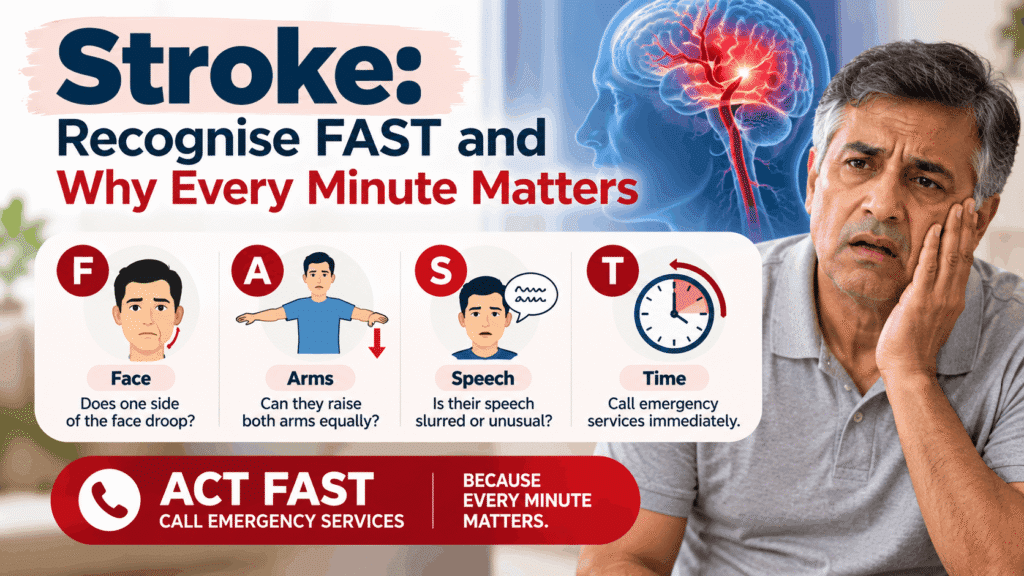
Remember, the FAST test is a quick and easy way to recognize the most common signs of stroke: Face, Arms, Speech, Time.
What Is a Stroke?
Your brain depends on a constant supply of blood and oxygen. When that supply is suddenly interrupted, brain cells in the affected area can begin to malfunction and become damaged.
There are two main types of stroke:
| Type | What happens |
|---|---|
| Ischemic stroke | A blood clot blocks an artery that supplies blood to the brain. |
| Hemorrhagic stroke | A blood vessel in or around the brain ruptures, causing bleeding. |
Ischemic strokes are more common, but the two types require different treatments. That’s one reason doctors need to perform brain imaging before deciding which treatment is appropriate.
There is also a condition called a transient ischemic attack (TIA). It can cause symptoms that look like a stroke but disappear after a short time.
That doesn’t mean everything is fine. A TIA can be a warning that a more serious stroke could occur, so temporary symptoms still need urgent medical attention.
How Do You Recognise a Stroke?
Stroke symptoms usually appear suddenly.
Someone may suddenly find that one side of their face feels weak, one arm won’t stay raised, or their speech doesn’t sound right. Other people may suddenly experience vision problems, dizziness, trouble walking, or a severe headache.
Some common symptoms include:
- Sudden weakness or numbness, particularly on one side of the body
- Drooping on one side of the face
- Slurred or unusual speech
- Difficulty understanding what others are saying
- Sudden problems with vision
- Loss of balance or coordination
- Sudden difficulty walking
- A sudden, severe headache with no obvious cause
The key word is sudden. If something changes unexpectedly, don’t assume the person is simply tired, stressed, or feeling unwell.
The FAST Test: A Simple Way to Spot Stroke
You don’t need to be a doctor to recognise some of the most important stroke warning signs.
The FAST test gives you a simple way to remember them.
F – Face
- Ask the person to smile.
- Does one side of their face droop? Does their smile look uneven?
- A new change in facial movement can be a warning sign of stroke.
A – Arms
- Ask the person to raise both arms.
- Can they lift both arms equally?
- If one arm suddenly feels weak or numb, or one arm starts drifting downward, take it seriously.
S – Speech
- Ask the person to repeat a simple sentence.
- Does their speech sound slurred? Are they struggling to find words? Are they saying something that doesn’t make sense?
- Sudden difficulty speaking or understanding speech can be another warning sign.
T – Time
- This is the part you don’t want to forget.
If you notice one or more of these symptoms, act.
- Call your local emergency medical service immediately.
- Don’t wait five minutes to see if the person feels better. Don’t wait until the next morning. And don’t assume that disappearing symptoms mean the danger has passed.
- The CDC recommends getting emergency help immediately when stroke symptoms occur.
What Is B.E. FAST?
You may also have seen another version called B.E. FAST.
It adds two symptoms that aren’t included in the traditional FAST acronym: balance and vision.
| Letter | What to look for |
| B – Balance | Sudden dizziness, loss of balance, or difficulty walking |
| E – Eyes | Sudden changes in vision |
| F – Face | Facial drooping |
| A – Arms | Sudden weakness or numbness in an arm |
| S – Speech | Slurred or unusual speech |
| T – Time | Get emergency medical help immediately |
The expanded version can be useful because stroke doesn’t always present with facial drooping or speech problems. Sudden balance or vision changes can also be important warning signs.
FAST and B.E. FAST are recognition tools, not diagnostic tests. Only a healthcare professional can determine whether someone is actually having a stroke.
What Should You Do If You Think Someone Is Having a Stroke?
This is where knowing the signs becomes crucial-it helps you respond immediately and effectively in an emergency.
If you suspect a stroke, focus on getting emergency help rather than trying to work out exactly what type of stroke it is.
1. Call emergency services
- Don’t wait for the symptoms to disappear.
- Tell the emergency operator that you suspect a stroke and describe the symptoms.
2. Remember when the symptoms started
- If you know the exact time symptoms began, note it.
- If you don’t know, think about the last time the person was definitely normal.
- This information can be extremely useful to the medical team because some stroke treatments are time-dependent.
3. Don’t give medication on your own
- A stroke can be caused by either a clot or bleeding.
- Because these situations require different treatments, don’t assume that giving a particular medication is appropriate.
- Let the emergency team assess the person.
4. Don’t wait because the symptoms seem mild
- A person doesn’t need to collapse or lose consciousness to be having a stroke.
- Even subtle symptoms that appear suddenly can be signs of a stroke and require urgent medical attention, not just severe ones.
5. If possible, use emergency medical transport
- Emergency medical professionals can begin assessment during transport and communicate with the receiving hospital.
Why Does Every Minute Matter in Stroke?
You’ve probably heard the phrase “time is brain.” It sounds dramatic, but it matters. When part of the brain doesn’t receive enough blood, the affected tissue is at risk of injury. The longer the blood supply is interrupted, the greater the risk of permanent damage. That’s why stroke treatment focuses so heavily on speed.
People sometimes also talk about the “golden hour”, but it is important not to misinterpret this expression. It does not mean that treatment becomes impossible precisely one hour after the event. Rather, the golden hour should be seen as a reminder that earlier recognition and treatment will offer more opportunities for appropriate intervention.
Some eligible people with ischemic stroke may receive intravenous thrombolytic treatment within 4.5 hours of symptom onset. Selected patients may also qualify for mechanical thrombectomy at later time points, depending on factors such as the location of the blockage and brain-imaging results.
So if someone develops stroke symptoms two hours after they were last known to be well, you should still call emergency services immediately.
The message isn’t:
“The golden hour is over.”
The message is:
“We need medical help now.”
What Is Thrombolysis?
Thrombolysis is a treatment that can help dissolve a blood clot in certain people who have an ischemic stroke. Medicines such as alteplase or tenecteplase may be considered for eligible patients within the appropriate treatment window. But thrombolysis isn’t suitable for everyone.
Doctors first need to establish what is happening in the brain and whether the benefits of treatment outweigh the risks. Brain imaging is an important part of this assessment because doctors need to distinguish a clot-related stroke from a bleeding stroke.
This is another reason why trying to treat a suspected stroke at home isn’t appropriate.
What Is Mechanical Thrombectomy?
Some ischemic strokes happen because a large blood vessel in the brain becomes blocked. In selected patients, doctors may remove the clot using a procedure called mechanical thrombectomy.
A thin catheter is guided through the blood vessels to the site of the blockage. Special equipment is then used to remove the clot and restore blood flow. Not everyone with a stroke will be eligible for thrombectomy. Doctors consider several factors, including:
- Where the blockage is located
- How severe the stroke is
- How much brain tissue may already be damaged
- Imaging findings
- When the person was last known to be well
Some carefully selected patients may benefit from thrombectomy even when several hours have passed since symptoms began. That is why getting to a hospital quickly matters, even if you’re not sure whether the person is still within a treatment window.
What Happens When You Reach the Hospital?
The first few minutes in the hospital can involve a lot of questions.
The medical team may want to know:
- What symptoms appeared?
- When were they first noticed?
- When was the person last known to be well?
- Does the person take blood-thinning medication?
- Do they have high blood pressure?
- Do they have diabetes?
- Have they had a previous stroke or TIA?
- Do they have atrial fibrillation or another heart condition?
Doctors may then perform brain imaging, such as a CT or MRI, depending on the situation and available resources. The purpose isn’t simply to answer “Is this a stroke?”
The team also needs to determine: What type of stroke is it? Where is the problem? How extensive is it? And which treatments could be appropriate?
Can You Reduce Your Stroke Risk?
Not every stroke can be prevented. Some factors such as age, family history, and certain medical conditions aren’t things you can simply change. But you can manage several important risk factors.
The World Health Organization has identified several causes of a stroke, among them high blood pressure, tobacco use, high cholesterol, high levels of blood sugar, lack of physical activity, an unhealthy diet, and being overweight.
Control Your Blood Pressure
- High blood pressure usually produces no noticeable symptoms.
- That is why a person can be completely healthy and yet have hypertension.
- Regular blood pressure checks and sticking to prescribed treatment can help reduce your risk of cardiovascular problems.
Don’t Smoke
- Smoking damages blood vessels and increases the risk of cardiovascular disease and stroke.
- If you smoke, quitting can be one of the important steps you can take for your health.
Keep Diabetes Under Control
- Over time, high blood glucose can damage blood vessels and contribute to cardiovascular complications.
- If you have diabetes or prediabetes, work with your healthcare professional on an appropriate plan for monitoring and managing your blood glucose.
Keep an Eye on Cholesterol
- High cholesterol can contribute to plaque buildup in blood vessels.
- Depending on your individual risk, your healthcare professional may recommend lifestyle changes, medication, or both.
Stay Active
- You don’t necessarily need an intense gym routine to become more active.
- Walking, cycling, swimming, dancing, household activities, or any other activity you enjoy can help you build a more active lifestyle.
- For many adults, the WHO recommends at least 150 minutes of moderate-intensity physical activity per week, though individual needs vary.
Build a Balanced Diet
- Healthy eating doesn’t have to mean completely giving up the foods you enjoy.
- Try to make vegetables, fruits, whole grains, pulses, nuts, seeds and appropriate protein sources regular parts of your meals.
- At the same time, limit excessive amounts of salt, highly processed foods, added sugars and unhealthy fats.
- Think consistency rather than perfection.
Stroke Risk Factors: What Can You Work On?
| Risk factor | What you can discuss with your healthcare professional |
| High blood pressure | Regular monitoring and appropriate treatment |
| Diabetes | Blood glucose monitoring and diabetes management |
| High cholesterol | Lipid testing, diet and medication when indicated |
| Smoking | Smoking cessation support |
| Physical inactivity | Gradually increasing daily activity |
| Excess weight | Sustainable nutrition and activity changes |
| Unhealthy diet | A balanced, heart-healthy eating pattern |
| Atrial fibrillation | Appropriate medical evaluation and treatment |
| Previous TIA or stroke | Individualised secondary prevention |
The right approach isn’t identical for everyone. If you’ve already had a stroke or TIA, prevention becomes particularly important and should be personalised by your healthcare team.
What If the Symptoms Go Away?
This is one of the most important things to understand. Suppose someone suddenly develops weakness in their right arm and difficulty speaking. After 10 minutes, everything appears normal again.
It might be tempting to think: “It’s gone, so we’re fine.”
Don’t make that assumption. Temporary stroke-like symptoms can occur with a transient ischemic attack (TIA). A TIA can be a warning sign of a future stroke and needs urgent medical assessment.
The fact that the symptoms disappeared doesn’t mean the situation is safe.
FAST Stroke Checklist
If you’re trying to remember everything we’ve discussed, keep it simple.
| FAST | Ask yourself |
| F – Face | Is one side of the face drooping? |
| A – Arms | Is one arm weak or numb? |
| S – Speech | Is the person’s speech suddenly unusual or difficult? |
| T – Time | Have emergency medical services been called? |
And remember B.E. FAST if you want to include sudden balance and vision problems.
A simple rule to remember
Sudden neurological symptom + no obvious explanation = don’t wait.
Get emergency medical help.
Frequently Asked Questions
1. What are the 5 signs of a stroke?
The traditional FAST method centres on facial drooping, weakness of the arm, difficulty with speech, and the importance of acting quickly. The B.E. FAST approach adds sudden problems with balance and changes in vision.
2. What is the FAST test for stroke?
FAST stands for Face, Arms, Speech, and Time, and it’s a simple tool that helps people recognize common stroke symptoms and seek emergency care quickly.
3. What is the golden hour for a stroke?
The “golden hour” is a period of time during which treatment needs to be provided to a stroke patient. This period is not limited to one hour of stroke care. Some forms of stroke treatment may still be appropriate for eligible patients several hours after symptoms begin, depending on the type of stroke as well as other factors.
4. Can a stroke be treated after 4.5 hours?
Yes, that is possible. Appropriate treatment varies by stroke type and the patient’s specific circumstances. Some patients may be eligible for mechanical thrombectomy at later time points based on clinical and imaging criteria. That is the reason why emergency assessment should never be delayed just because several hours have passed.
5. Can stroke symptoms disappear?
Yes. Temporary symptoms can occur with a TIA. Even when symptoms disappear, urgent medical assessment is important because a TIA can signal an increased risk of stroke.
Conclusion: Remember FAST, Then Act
You don’t need to memorise a medical textbook to recognise a possible stroke.
Remember:
F – Face
A – Arms
S – Speech
T – Time
If someone suddenly develops one of these warning signs, don’t waste time deciding whether it’s “serious enough.” Call emergency medical services.
The sooner a person is evaluated, the sooner doctors can tell what is going on and whether time-sensitive treatment is appropriate. And don’t forget that the “golden hour” is a plea to act quickly, not a deadline after which help is useless. About stroke, each minute should be taken seriously.
Medical disclaimer: The article is provided for general educational use and should not be regarded as a replacement for professional medical advice. Should you or anyone nearby begin to show sudden symptoms that might point to a stroke, you should go at once to an emergency medical facility.
References
- https://www.cdc.gov/stroke/signs-symptoms/index.html
- https://www.who.int/news-room/fact-sheets/detail/stroke
- https://www.stroke.org/en/about-stroke/stroke-symptoms
- https://www.stroke.org/en/about-stroke/types-of-stroke/ischemic-stroke-clots
- https://www.cdc.gov/stroke/risk-factors/index.html