Quick Answer
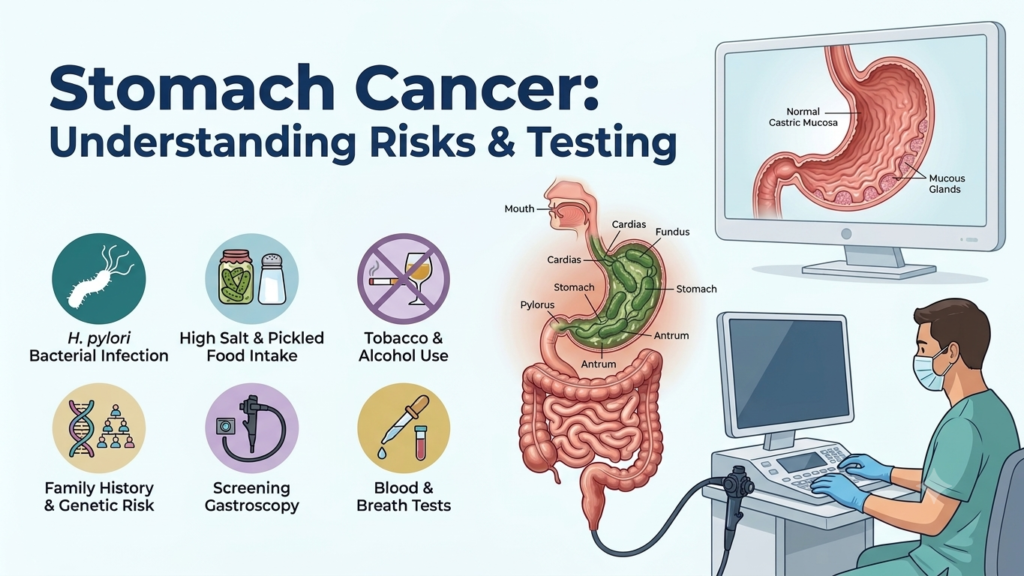
Stomach cancer is a type of cancer that arises in the lining of the stomach. Long-term infection can cause chronic inflammation and alter the stomach lining, so H. pylori infection is a significant risk factor. Other risk factors are smoking, having a family history of stomach cancer, certain inherited disorders, and eating a diet rich in salted or smoked foods.
Stomach cancer, or gastric cancer, arises when abnormal cells in the lining of the stomach start to grow without control. It may develop slowly, and in the early stages, stomach cancer might not produce any obvious symptoms.
Infection with Helicobacter pylori (H. pylori), a bacterium that can live in the stomach and cause chronic inflammation, is a major risk factor. Yet the presence of H. pylori does not imply that a person will certainly develop stomach cancer.
What Is Stomach Cancer?
Stomach cancer occurs when the cells in the stomach lining undergo abnormal changes and begin to grow out of control.
The stomach forms part of the digestive system and aids in the breakdown of food before it reaches the small intestine. The majority of stomach cancers are adenocarcinomas, a type that arises in the glandular cells that line the stomach.
Stomach cancer may occur in various sections of the stomach, and the symptoms and treatment will depend on the part where it first appears and how far it has spread.
What Is H. pylori?
H. pylori, also known as Helicobacter pylori, is a bacterium that can infect the stomach lining.
Although a great many people infected with H. pylori do not have any noticeable symptoms, in some cases the infection can lead to chronic inflammation of the stomach lining and be associated with conditions like gastritis and peptic ulcers.
A long-term infection with H. pylori is also linked to a greater risk of some forms of stomach cancer.
It is important to note that the majority of people who have an infection with H. pylori do not go on to develop stomach cancer; the infection is just one of several risk factors.
What does H. pylori do to increase the risk of stomach cancer?
Pylori can produce continuous inflammation in the stomach, and after several years, this chronic inflammation may result in alterations to the cells that line the stomach.
This process may at times go through several changes, such as atrophic gastritis and intestinal metaplasia, and this can raise the risk of gastric cancer.
The good news is that H. pylori can be identified and treated; if an infection is suspected, your healthcare provider will be able to suggest the right tests and treatment.
Risk Factors for Stomach Cancer
The presence of one or more risk factors does not guarantee that you will develop stomach cancer, but it does mean that you may want to consider talking to a healthcare professional about your risk.
1. H. pylori Infection
One of the most well-established risk factors for stomach cancer is a long-term infection with H. pylori.
The risk of developing gastric cancer can be reduced by treating the infection, especially if the treatment takes place before substantial precancerous changes have developed.
2. Smoking
There is a greater risk of stomach cancer among people who smoke, since tobacco smoke contains substances capable of damaging cells and leading to the development of cancer.
Giving up smoking can decrease the chances of getting several types of cancer, such as those that affect the digestive system.
3. Family History
The presence of a close family member who has stomach cancer can lead to an increased risk for you.
In certain families, inherited genetic mutations can also lead to a higher risk. In such cases, genetic counselling may at times be advised.
4. Diet
It has been found that eating a diet which is often based on salt-preserved, smoked, or badly preserved foods increases the risk of developing stomach cancer.
Consuming a greater amount of fresh fruit and vegetables and at the same time restricting one’s intake of highly salted or preserved foods can help to promote general health.
5. Age
The likelihood of getting stomach cancer usually goes up as one gets older, with it being more frequently diagnosed in older adults, even though it can also occur in younger individuals.
6. Certain Medical Conditions
Certain conditions of the stomach may raise the risk of gastric cancer, such as chronic atrophic gastritis and intestinal metaplasia.
In some individuals, an increased risk may also be linked to certain kinds of stomach polyps or to having undergone previous stomach surgery.
7. Inherited Conditions
Certain genetic conditions that are inherited can increase a person’s risk of developing stomach cancer.
For instance, hereditary diffuse gastric cancer (HDGC) is linked to inherited mutations in the CDH1 gene and can greatly increase the risk of some gastric cancers.
Early Signs and Symptoms of Stomach Cancer
Early stomach cancer usually does not cause any noticeable symptoms, and when it does, the symptoms can be similar to those of common digestive disorders.
Possible symptoms include:
- Persistent indigestion or discomfort in the upper abdomen
- Feeling bloated after eating
- Feeling full after eating only a small amount
- Nausea or vomiting
- Loss of appetite
- Heartburn or acid reflux
- Unexplained weight loss
- Difficulty swallowing
- Blood in the stool or black, tarry stools
- Persistent tiredness or weakness
The fact that these symptoms appear does not prove that one has stomach cancer; conditions like gastritis, acid reflux, ulcers, and various other digestive disorders can lead to the same symptoms.
Symptoms that continue, get worse, or happen at the same time should be looked at.
Why Early Diagnosis Matters
Stomach cancer is more difficult to pick up in its early stages since the first symptoms might be mild or non-specific.
If stomach cancer is found in its early stage, the treatment available may be different from that available when the cancer has already spread.
Because of this, individuals who have ongoing symptoms or who have important risk factors should talk to a healthcare professional about their concerns.
How do you diagnose stomach cancer?
For people at average risk in countries like the United States, there is no routine screening test that is recommended. Nevertheless, doctors will suggest that people who have symptoms or are at higher risk should have their condition evaluated.
Diagnosis may take several steps.
Upper Endoscopy
An upper gastrointestinal endoscopy, or EGD, is one of the primary procedures employed in the examination of the stomach.
A thin, flexible tube fitted with a camera is inserted through the mouth and guided into the esophagus, the stomach, and the first section of the small intestine during the procedure.
The doctor may search for any abnormal areas and take biopsy samples for examination in a laboratory.
Biopsy
A biopsy consists of taking a small amount of tissue so that it may be looked at under a microscope.
A biopsy is usually required in order to find out if the abnormal tissue contains cancer cells.
H. pylori Testing
When H. pylori infection is suspected, testing could involve:
- Breath tests
- Stool tests
- Blood tests in certain circumstances
- Testing of tissue obtained during endoscopy
Your doctor will be able to decide which test is the right one.
Can H. pylori be treated?
Yes, H. pylori infection can usually be treated by using a combination of antibiotics and medications that reduce acid. The specific course of treatment depends on factors such as the level of antibiotic resistance in the area and the patient’s past treatment history.
Following treatment, a follow-up test might be suggested to make sure that the infection has been successfully got rid of.
It is important to take the full course of treatment exactly as prescribed and not to stop the antibiotics early.
Can stomach cancer be prevented?
It is not possible to prevent all instances of stomach cancer, but some things may help lower the risk.
These include:
- Testing and treating H. pylori when it is medically appropriate
- Avoiding tobacco
- Eating a balanced diet with plenty of fruits and vegetables
- Limiting heavily salted and preserved foods
- Maintaining a healthy lifestyle
- Discussing family history and inherited risk with a healthcare professional
Individuals who have specific genetic conditions that are associated with a high risk or who show precancerous changes in the stomach might need personally tailored surveillance or preventive measures.
When is it time to see a doctor?
It is common to experience occasional indigestion or bloating, and this does not always mean that one has stomach cancer.
However, you should consider speaking with a healthcare professional if you have persistent or worsening digestive symptoms, particularly if they are accompanied by:
- Unexplained weight loss
- Difficulty swallowing
- Persistent vomiting
- Blood in the stool or black stools
- Loss of appetite
- Ongoing upper abdominal discomfort
- Unexplained anemia or persistent tiredness
Early evaluation can assist in deciding if the symptoms are due to a common digestive disorder or if they indicate the need for further investigation.
Frequently Asked Questions
1. Can infection with H. pylori lead to stomach cancer?
Pylori infection is known to be a risk factor for some forms of stomach cancer since it can lead to chronic inflammation and alter the stomach lining. Yet the majority of individuals infected with H. pylori do not go on to develop stomach cancer.
2. Does every individual with H. pylori require treatment?
H. pylori infection is usually treated once it has been confirmed, but the right course of action should be decided upon by a healthcare professional taking into account the individual’s medical history and the current guidelines.
3. What are the initial signs of stomach cancer?
Early stomach cancer might produce no symptoms at all. The symptoms that do appear can be persistent indigestion, discomfort in the upper abdomen, a feeling of bloating, becoming full very quickly, nausea, a loss of appetite, and unexplained weight loss.
4. Is stomach cancer hereditary?
The majority of stomach cancers are not inherited, although some genetic conditions are inherited, such as hereditary diffuse gastric cancer, which can greatly increase the risk.
5. Is there a test available for the early detection of stomach cancer?
In many countries, routine screening is not advised for all individuals who are of average risk, and those who are at higher risk may need individually tailored surveillance, possibly involving upper endoscopy.
6. Can cancer of the stomach be cured if it is detected early?
Early-stage stomach cancer can, in some cases, be successfully treated, but the results will vary according to factors such as the stage, the location, the type of cancer, the patient’s general health, and their response to treatment. Generally, an early diagnosis leads to a greater number of treatment options.
Conclusion
Stomach cancer can progress silently, and the early signs may resemble those of ordinary digestive disorders. Although infection with H. pylori is an important and treatable risk factor, it is only one element of the whole situation.
Being aware of your risk factors, noticing any persistent symptoms, avoiding tobacco, following a healthy diet, and asking a healthcare professional about testing for H. pylori when it is appropriate are all ways of improving your stomach health.
Whenever you are suffering from persistent indigestion, unexplained weight loss, difficulty in swallowing, ongoing abdominal discomfort, vomiting, or symptoms of gastrointestinal bleeding, don’t just assume that it’s ordinary acidity or indigestion; it’s important to have the cause investigated.
References
1.https://www.cancer.gov/types/stomach
2.https://www.cancer.org/cancer/types/stomach-cancer/causes-risks-prevention/risk-factors.html
3.https://www.cancer.org/cancer/types/stomach-cancer/detection-diagnosis-staging/signs-symptoms.html
4.https://www.cancer.gov/types/stomach/hp/stomach-prevention-pdq
6.https://www.niddk.nih.gov/health-information/digestive-diseases/peptic-ulcers-stomach-ulcers
7.https://pubmed.ncbi.nlm.nih.gov/39626064/