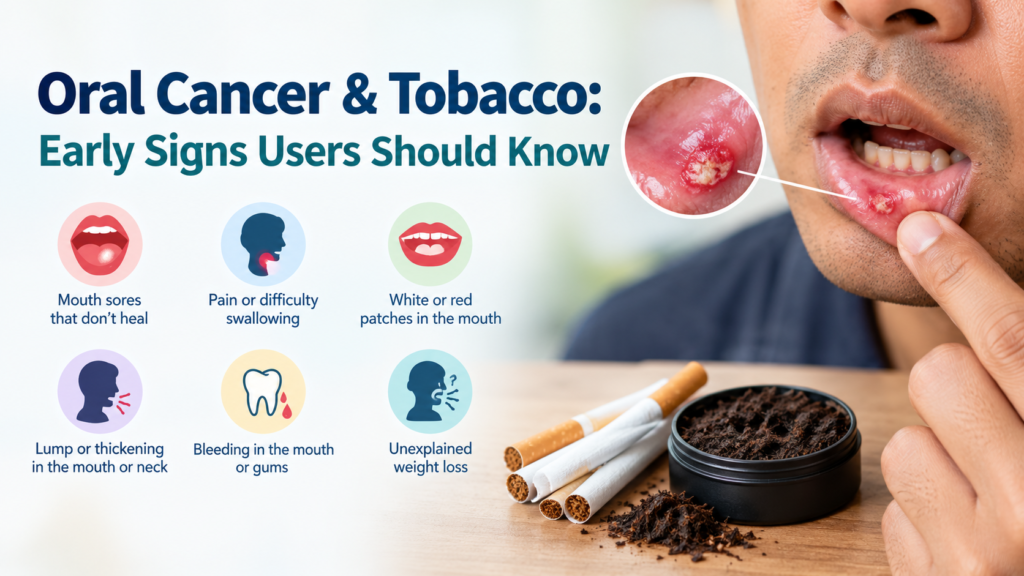
Oral Cancer & Tobacco: The first warning sign for people who use gutka and pan masala is a painless sore, ulcer, or a red or white patch in the mouth that fails to heal within two to three weeks. The frequent use of smokeless tobacco and areca nut products such as gutka and pan masala causes damage to the oral tissues. It may result in premalignant lesions or oral squamous cell carcinoma.
Introduction
In India, it is common to use gutka, pan masala, khaini, chewing tobacco, and various other smokeless tobacco products. As these products do not produce smoke, some people might incorrectly believe that they are safer than cigarettes. However, smokeless tobacco can cause oral cancer, and those products that contain areca nut, such as many kinds of gutka and pan masala, are also associated with serious oral health problems.
The International Agency for Research on Cancer (IARC) considers all types of tobacco to be a major risk factor for oral cancer, and it has also determined that areca nut—which is generally found in chewing tobacco—is carcinogenic to humans.
Should minor changes in the mouth be noticed, this could cause individuals to have a medical examination earlier. The fact that a person has a mouth ulcer, a white patch, a red patch, or difficulty in opening the mouth does not necessarily mean that they have cancer, but persistent or unusual changes should not be ignored.
How Gutka and Pan Masala Can Affect Oral Health
Gutka and various other types of chewing tobacco can contain tobacco, areca nut, slaked lime, catechu, and flavouring agents; in the case of pan masala, the areca nut may be included even if tobacco is not present.
Smokeless tobacco contains nicotine, a substance which is addictive, and also has carcinogens that can damage the tissues in the mouth; according to the National Cancer Institute, smokeless tobacco can cause oral cancer and may also result in precancerous lesions such as leukoplakia.
Areca nut is also a serious issue because if it is frequently consumed, it can cause oral submucous fibrosis (OSF), a condition that may be precancerous and which can lead to the progressive stiffening of the mouth tissues as well as difficulty in opening the mouth.
One should not think that giving up gutka and taking up tobacco-free pan masala is a safe alternative; the IARC has made it clear that areca nut is carcinogenic to humans.
Early Warning Signs of Oral Cancer
Other causes of oral changes besides cancer exist. However, any symptoms that last for more than two weeks should be examined by a dentist or doctor.
1. A mouth ulcer that does not heal
A minor mouth ulcer generally heals quickly. However, if any ulcer or sore lasts for a long time, keeps recurring, increases in size, or is in any other way unusual, it should be looked at by a professional.
The National Institute of Cancer Prevention and Research in India states that people should have a medical examination if oral symptoms continue for more than two weeks.
2. There are white spots inside the mouth.
A persistent white patch in the mouth—whether it be on the tongue, the gums, the cheek, or somewhere else—might be a sign of leukoplakia or some other oral condition.
Leukoplakia can be a precancerous condition, particularly in people who use smokeless tobacco.
3. Those patches which are red or consist of red and white
One must not ignore a spot that is red or a region that has both red and white changes if it persists.
The lesions can have a number of causes, but in certain instances they might be a sign of possible precancerous changes and so will have to be examined.
4. An area that has thickened or become lumpy
Look for an unexplained lump, thickening, swelling, or hard area on the:
- Tongue
- Gums
- Inner cheek
- Lips
- Floor of the mouth
- Jaw or neck
They must be evaluated unless they resolve the issue.
5. Opening the mouth is difficult.
People who frequently chew articles that contain areca nut may develop a condition called oral submucous fibrosis, one of the key symptoms of which is increasing difficulty in opening the mouth.
Consequently, it becomes harder and harder to eat, to talk, and to maintain good oral hygiene.
6. It may cause a burning or painful feeling in the mouth.
There are a great many possible causes of a continuing burning, aching, or sudden pain in the mouth or on the tongue; yet in these instances, where the symptoms persist or are associated with a visible lesion, a medical evaluation is important.
7. Unexplained bleeding
Bleeding from the mouth when there is no obvious injury should be evaluated, in particular if it occurs repeatedly or is associated with a persistent sore or lump.
8. Difficulties with chewing or swallowing
There are various oral and throat conditions which can cause difficulty with chewing or swallowing, and it should not be taken for granted that a continuing problem is the result of tobacco use or aging; it should be assessed.
9. Difficulties with loose teeth or dentures
Loose teeth for no obvious reason or a change in how well dentures fit may, in some cases, be due to an oral disease. The NICPR lists loose teeth and dentures that fit improperly as symptoms which ought to attract attention.
10. A mass in the neck
A lump or hard mass in the neck, even if the cause is unknown, could be related to head and neck cancers and therefore should be assessed by a healthcare professional.
11. Changes in voice
A person might continue to have a hoarse voice or might notice a change in their voice for which no reason can be given if the cancer impacts any part of the throat or larynx, and the condition should then be assessed if it doesn’t improve.
12. Unexplained weight loss
Unintentional weight loss is associated with a wide range of health problems and, in these instances, if there are continuous oral symptoms, difficulty in swallowing, or any other worrying changes, a medical examination should be carried out.
Why Gutka Users Should Pay Attention to Oral Changes
The risk is not limited to those who smoke cigarettes.
The World Health Organization and the International Agency for Research on Cancer consider the use of smokeless tobacco and areca nut to be major causes of oral cancer, particularly in regions where these products are widely used.
In India, smokeless tobacco presents a serious problem from a public health point of view,w and the World Health Organization for India regards products such as gutka, khaini and betel quid, which contain tobacco, as examples of the various types of smokeless tobacco that are commonly used.
Concern is especially aroused when tobacco and alcohol are used together because exposure to both of them can further increase the likelihood of developing cancers of the oral cavity and other associated areas.
Can pan masala that does not contain tobacco be considered safe?
No.
The fact that a product is referred to as “tobacco-free” doesn’t mean that it is without danger.
Many pan masala products contain areca nut (supari); the IARC has said that areca nut is a carcinogen for humans and has linked its use closely to oral submucous fibrosis and oral cancer.
One should not suppose that giving up gutka and using tobacco-free pan masala removesone’sr chance of getting oral cancer.
What should one do when a warning sign is seen?
Do not wait until the symptom has started to cause pain.
Should you spot an ulcer that persists, or if you observe a white or red patch, a lump, unexpected bleeding, difficulty in opening your mouth, or any other unusual change which continues for over two weeks, you should have yourself examined by a dentist, an oral medicine specialist, an ENT specialist, or a doctor.
A healthcare professional may examine the mouth, tongue, gums, cheeks, throat, and neck in order to work out whether any further tests are necessary.
It should be noted that whilst not all mouth lesions are cancerous, the symptoms in such cases should simply be properly evaluated rather than being self-diagnosed.
The Best Way to Reduce Your Risk
The best method of preventing this is to give up tobacco and to avoid using areca-nut products.
Stopping smoking is difficult since nicotine is addictive, so those who wish to quit should get help from a healthcare professional or a tobacco-cessation service rather than attempting to cope with the withdrawal on their own.
The IARC assessment of the evidence states that, in order to reduce one’s risk of oral cancer,r it is necessary to avoid or cease using tobacco and areca nut.
Other practical measures include:
- Avoid gutka, khaini, and all other smokeless tobacco products.
- Avoid using areca nut or any products containing supari.
- It is advisable to avoid using tobacco together with heavy alcohol consumption.
- Maintain good oral hygiene.
- Any oral lesions that persist should be looked at as soon as possible.
- Attend regular dental check-ups.
- You ought not to ignore changes merely because they are painless.
Frequently Asked Questions
1. Can gutka cause oral cancer?
That is right; many types of gutka contain smokeless tobacco, which is known to cause oral cancer, and gutka may also contain areca nut, which is itself carcinogenic.
2. Is pan masala safer than gutka?
It needn’t be that way since some pan masala products contain areca nut, which is carcinogenic, and therefore being tobacco-free does not mean that it is risk-free.
3. Does oral cancer always have to cause pain?
By no means; certain oral cancers or precancerous conditions may initially cause either no pain or only mild pain. It therefore follows that painless white or red patches, ulcers, or lumps should not be merely ignored.
4. Will ceasing to use gutka decrease the risk of oral cancer?
To reduce your risk of oral cancer, you should stop being exposed to both tobacco and areca nut; giving up tobacco also helps in the prevention of other diseases linked to it.
5. Is it possible to prevent oral cancer?
A great many of the factors which increase the risk of oral cancer can be reduced. It is possible to greatly reduce this risk by avoiding the use of tobacco, smokeless tobacco, areca nut, and excessive alcohol; it is also important to have early evaluation of any persistent oral lesions.
References:
1.https://www.iarc.who.int/teams-oct/
3.https://www.cancer.gov/about-cancer/causes-prevention/risk/tobacco/smokeless-fact-sheet
4.https://www.cancer.gov/types/head-and-neck/patient/oral-prevention-pdq
6.https://www.who.int/india/health-topics/tobacco