

Hypertension, commonly known as high blood pressure, remains one of the most significant global health challenges of the 21st century. Often referred to as the “silent killer,” hypertension frequently develops without noticeable symptoms yet significantly increases the risk of cardiovascular diseases, stroke, kidney failure, and premature death.
According to global health estimates, approximately 1.4 billion adults aged 30–79 years were living with hypertension in 2024, representing nearly one-third of the world’s adult population. Alarmingly, nearly 44% of individuals with hypertension remain unaware of their condition, while only about 23% have their blood pressure adequately controlled.
In response to this growing public health issue, several international medical organizations have released updated clinical guidelines to improve the detection, management, and prevention of hypertension. These include recommendations from leading authorities such as the American Heart Association (AHA), European Society of Cardiology (ESC), European Society of Hypertension (ESH), and the World Health Organization (WHO). This article summarizes the latest hypertension guidelines, highlighting diagnostic thresholds, risk factors, treatment strategies, and prevention approaches recommended in recent global clinical practice guidelines.
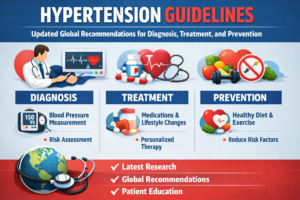

Hypertension
Hypertension occurs when the force of blood against artery walls remains consistently elevated. Blood pressure readings are expressed using two values:
- Systolic blood pressure (SBP): Pressure when the heart contracts
- Diastolic blood pressure (DBP): Pressure when the heart relaxes between beats
A blood pressure reading is typically written as SBP/DBP (mmHg).
Most clinical guidelines diagnose hypertension when repeated readings show systolic pressure ≥140 mmHg or diastolic pressure ≥90 mmHg. However, some guidelines in the United States use 130/80 mmHg as the threshold for diagnosis.
Persistent hypertension increases strain on the heart and blood vessels, leading to long-term damage across multiple organ systems.
Global Burden of Hypertension
- Hypertension continues to rise worldwide due to factors such as urbanization, sedentary lifestyles, unhealthy diets, and population aging.
- The burden is particularly severe in low- and middle-income countries, where nearly two-thirds of individuals with hypertension live.
- Despite the availability of effective treatments, poor awareness, limited healthcare access, and inconsistent monitoring contribute to uncontrolled hypertension in millions of patients.
- Reducing uncontrolled hypertension is one of the key global targets for noncommunicable disease prevention, with international health organizations aiming to reduce prevalence by 25%.
Risk Factors for Hypertension
Hypertension develops due to a combination of modifiable and non-modifiable factors.
Modifiable Risk Factors
These lifestyle-related factors significantly increase the likelihood of developing hypertension:
- High sodium intake
- Diets high in saturated and trans fats
- Physical inactivity
- Tobacco use
- Excess alcohol consumption
- Overweight or obesity
- Chronic stress
- Air pollution exposure
Non-Modifiable Risk Factors
Some individuals have an increased risk due to biological or genetic factors:
- Family history of hypertension
- Age above 65 years
- Coexisting conditions such as diabetes or kidney disease
- Genetic predisposition
Addressing modifiable risk factors plays a critical role in preventing and controlling hypertension.
Symptoms and Clinical Presentation
Hypertension often progresses silently, with many patients experiencing no noticeable symptoms. This makes regular blood pressure screening essential.
However, in severe or uncontrolled cases, symptoms may include:
- Severe headaches
- Chest pain
- Blurred vision
- Dizziness
- Shortness of breath
- Nausea and vomiting
- Irregular heart rhythm
- Nosebleeds
- Anxiety or confusion
A hypertensive crisis occurs when blood pressure rises to 180/120 mmHg or higher, potentially causing organ damage. This condition requires immediate medical attention.
Table 1: Blood Pressure Classification Based on Recent Clinical Guidelines
| Category | Systolic BP (mmHg) | Diastolic BP (mmHg) |
| Normal Blood Pressure | <120 | <80 |
| Elevated Blood Pressure | 120–129 | <80 |
| Stage 1 Hypertension | 130–139 | 80–89 |
| Stage 2 Hypertension | ≥140 | ≥90 |
| Severe Hypertension | ≥180 | ≥120 |
| Hypertensive Emergency | ≥180 with symptoms | ≥120 with symptoms |
These classifications guide clinicians in determining appropriate management strategies.
Diagnostic Approaches
Hypertension diagnosis requires consistent blood pressure measurements on at least two separate occasions. Accurate diagnosis may involve:
- Office blood pressure measurements
- Home blood pressure monitoring (HBPM)
- Ambulatory blood pressure monitoring (ABPM)
Healthcare providers may also perform additional tests to assess organ damage and cardiovascular risk, including:
- Blood chemistry tests
- Lipid profile
- Kidney function tests
- Electrocardiogram (ECG)
- Urinalysis
- Imaging studies when necessary
These evaluations help identify underlying causes and guide treatment planning.
Treatment Strategies in Current Guidelines
Hypertension management typically involves a combination of lifestyle modification and pharmacological therapy.
Lifestyle Modification
Lifestyle interventions are recommended for all individuals with elevated blood pressure, regardless of medication use.
Key lifestyle changes include:
- Reducing salt intake (less than 2 grams per day)
- Increasing consumption of fruits and vegetables
- Maintaining a healthy body weight
- Engaging in regular physical activity
- Quitting smoking
- Limiting alcohol consumption
- Managing stress levels
Regular physical activity is particularly beneficial. Adults should aim for at least 150 minutes of moderate-intensity exercise per week.
Pharmacological Treatment
When lifestyle changes alone are insufficient, healthcare providers may prescribe medications to control blood pressure.
Common classes of antihypertensive medications include:
- ACE inhibitors (e.g., enalapril, lisinopril)
- Angiotensin receptor blockers (ARBs) (e.g., losartan, telmisartan)
- Calcium channel blockers (e.g., amlodipine)
- Diuretics (e.g., hydrochlorothiazide, chlorthalidone)
- Beta-blockers
The choice of medication depends on factors such as patient age, underlying diseases, and overall cardiovascular risk.
Table 2: Common Antihypertensive Drug Classes and Their Functions
| Drug Class | Examples | Primary Mechanism | Additional Benefits |
| ACE Inhibitors | Enalapril, Lisinopril | Relax blood vessels | Protect kidney function |
| ARBs | Losartan, Telmisartan | Block angiotensin II receptors | Reduce cardiovascular risk |
| Calcium Channel Blockers | Amlodipine, Felodipine | Relax arterial muscles | Improve blood flow |
| Diuretics | Hydrochlorothiazide, Chlorthalidone | Remove excess fluid | Reduce blood volume |
| Beta-Blockers | Atenolol, Metoprolol | Slow heart rate | Useful in heart disease |
Combination therapy is often recommended when single-drug therapy does not achieve adequate blood pressure control.
Target Blood Pressure Goals
Guideline recommendations emphasize individualized blood pressure targets.
Typical goals include:
- <130/80 mmHg for patients with cardiovascular disease, diabetes, or chronic kidney disease
- <140/90 mmHg for most adults with hypertension
- Adjusted targets for elderly or frail patients
Achieving these targets significantly reduces the risk of stroke, heart attack, and other complications.
Complications of Uncontrolled Hypertension
Untreated hypertension can damage multiple organ systems. Common complications include:
Cardiovascular Complications
- Coronary artery disease
- Heart attack
- Heart failure
- Irregular heart rhythms
Neurological Complications
- Stroke
- Cognitive decline
- Dementia
Renal Complications
- Chronic kidney disease
- Kidney failure
Other Effects
- Vision loss due to hypertensive retinopathy
- Peripheral artery disease
Early detection and proper management are crucial for preventing these life-threatening complications.
Prevention Strategies
Preventing hypertension requires a comprehensive approach combining lifestyle interventions and public health strategies.
Key preventive measures include:
- Eating a balanced, low-salt diet
- Maintaining a healthy body weight
- Exercising regularly
- Avoiding tobacco products
- Limiting alcohol consumption
- Managing stress
- Monitoring blood pressure regularly
Community-based programs such as the Global HEARTS Initiative aim to strengthen hypertension control worldwide by improving treatment protocols, access to medications, and patient education.
Global Efforts to Combat Hypertension
- International organizations such as the World Health Organization (WHO) continue to support countries in improving hypertension prevention and management.
- Programs like the Global Hearts Initiative promote standardized treatment protocols and improved access to essential medications.
- Since its implementation, millions of individuals in low- and middle-income countries have gained access to evidence-based hypertension treatment.
- These efforts demonstrate that coordinated healthcare strategies can significantly reduce the burden of cardiovascular diseases globally.
Conclusion
- Hypertension remains one of the leading causes of preventable illness and death worldwide.
- Despite advances in medical treatment, millions of people remain undiagnosed or inadequately treated.
- Recent clinical guidelines emphasize the importance of early detection, lifestyle modification, and appropriate pharmacological therapy.
- Regular blood pressure monitoring, patient education, and accessible healthcare services are essential to improving outcomes.
References
- https://www.who.int/news-room/fact-sheets/detail/hypertension
- https://emedicine.medscape.com/article/241381-guidelines?form=fpf
- https://my.clevelandclinic.org/health/diseases/4314-hypertension-high-blood-pressure
- https://pmc.ncbi.nlm.nih.gov/articles/PMC8740276/
- Unger, T., Borghi, C., Charchar, F., Khan, N. A., Poulter, N. R., Prabhakaran, D., … & Schutte, A. E. (2020). 2020 International Society of Hypertension global hypertension practice guidelines. Hypertension, 75(6), 1334-1357.
- Mancia, G., & Dominiczak, A. (2020). The new International Society of Hypertension guidelines on hypertension. Journal of Hypertension, 38(6), 981.
- Suvila K, McCabe EL, Lehtonen A, Ebinger JE, Lima JAC, Cheng S, Niiranen TJ. Early Onset Hypertension Is Associated with Hypertensive End-Organ Damage Already by MidLife. Hypertension. 2019 Aug;74(2):305-312. doi: 10.1161/HYPERTENSIONAHA.119.13069. Epub 2019 Jul 1. PMID: 31256722; PMCID: PMC6938569.